




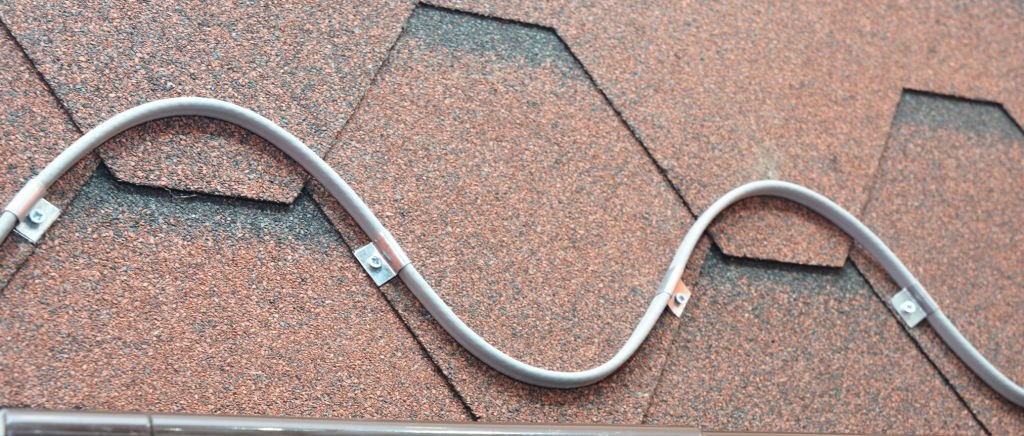
There are a great many different heating cables to be found on the market nowadays. All with a different operation, and a different way to control them. At Warmtekabel we also have various cables available, which can work with or without control. The advantage of an external controller is that the cable does exactly what you have set it to do. Now, choosing a good controller is just as important as the cable. We at Warmtekabel are happy to explain which controller is best to choose, in combination with the right cable!
How does an external control work with a heating cable?
The controller or thermostat on a heating cable ensures that it always delivers the right output. You can set a specific temperature range on a controller (depending on the model) or a specific temperature. The thermostat then ensures that the heating cable does not go outside this temperature range or continues to operate constantly at the specific temperature that has been set. By means of a temperature sensor that is supplied with most controllers, the ambient temperature is measured, or the location where you want the temperature to be measured. Using these measured temperatures, the thermostat registers whether or not the heating cable needs to be switched on.
If you want to change the set temperatures, this is also very easy. You can adjust this yourself on the controller, after which the heating cable will immediately start working at the adjusted temperature range or specifically set temperature.
Which heating cable has a control system?
Our heating cables are divided into two types. Self-regulating and constant wattage heating cables. A self-regulating heating cable automatically adjusts to the ambient temperature. In practice, we often see that no control system is required with a self-regulating heating cable. Of course, this is always possible if desired.
A constant wattage cable often requires a control system. This is because the cable does not adapt to the ambient temperature and emits the same output along its entire length. If no external control system is used with this cable, it can cause the cable, and consequently the application in which it is used, to become too hot.
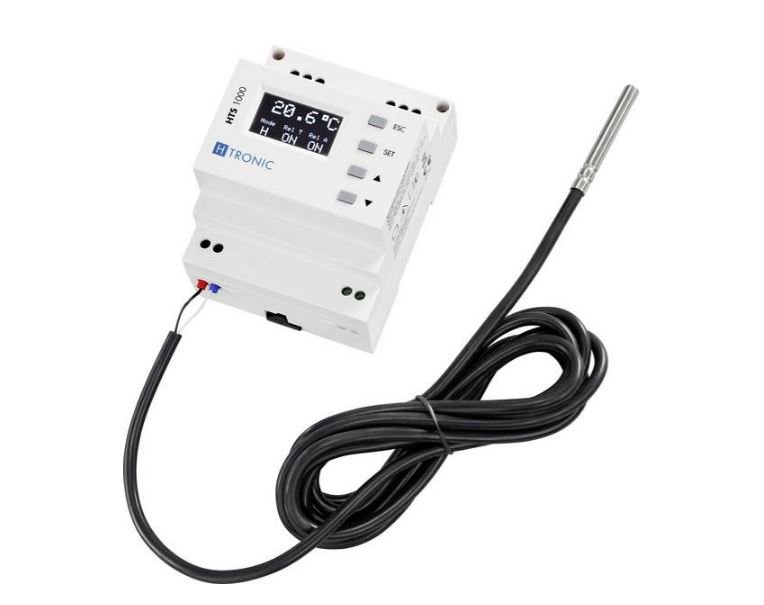
HTS-1000
A well-known scheme in our range is the HTS-1000. This measures the ambient temperature using a Pt1000 temperature sensor and is frequently deployed with our constant wattage heating cables. The HTS-1000 has a measuring range of -99 to +850 degrees Celsius. The supplied temperature sensor has a measuring range of -50 to +150 degrees Celsius. Due to this large measuring range, this temperature controller can be used in many different applications.
There is also the option to place this temperature controller in an IP65 housing, so that it can also be used in humid or dusty environments. For the heating cable, this controller has 2 potential-free contacts.
Combine with a heating cable
This temperature control is often combined with the 11SRF heating cable without clixon. Without a built-in thermostat, this cable is a constant power cable. It therefore delivers its full power (11W/m) constantly when switched on. With the HTS-1000, you can control this cable very easily from a distance. This is often done at a specific temperature at which the cable must function to keep a particular application frost-free.
Due to the relatively low power output, this cable is rarely used for actively heating an application. It is more frequently deployed to keep pipes, tubes or gutters frost-free. Therefore, we also always recommend choosing the IP-65 housing if this controller is installed outdoors.
Combining heating cables with the right control system at Warmtekabel
The combination mentioned above is just one of many. Do you have a heating cable in mind that comes with a recommended controller?






Recent Comments