




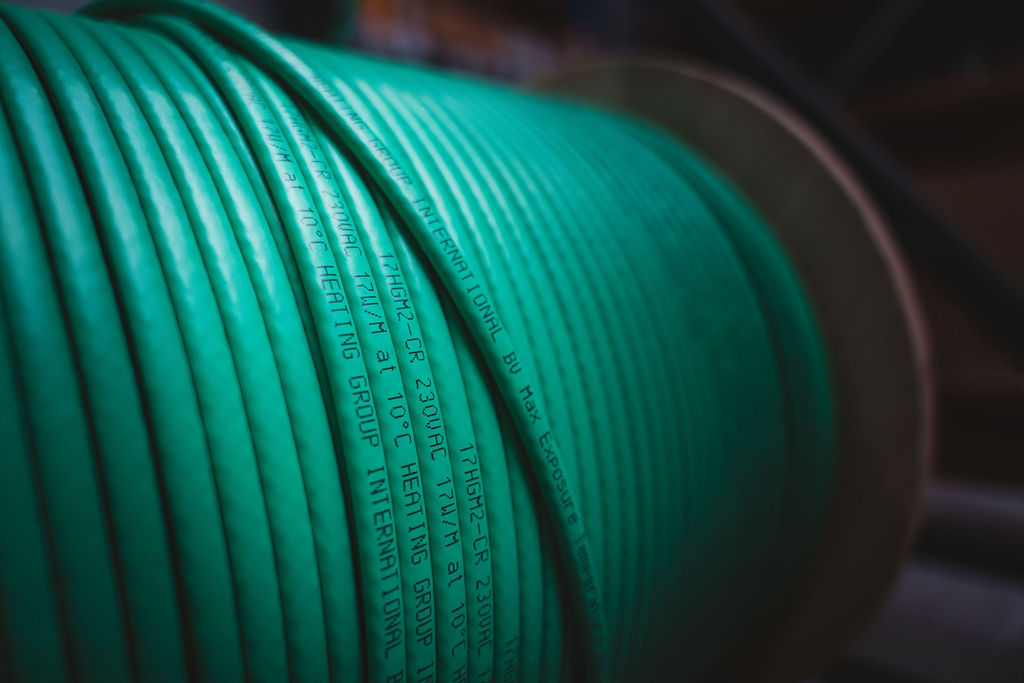
Protecting water pipes against frost is very important to prevent cracks and bursting in the pipe. If a pipe becomes damaged, this can result in leaks, which can also entail high costs. This situation is very easy to resolve with a heating cable. The heating cable is different for every pipe, so how do you choose the right cable for your water pipe? We are happy to explain it to you!
Determine power
When you a heating cable will be using to keep your water pipe frost-free, it is important to determine how much power you need. This is mainly determined by the diameter of your water pipe. The larger the diameter, the more power is required to keep it frost-free.
When determining the power output, we always apply the following measurements:
- Pipe diameter of
- Pipe diameter from 25 to 50mm: 11W/m with good insulation, 25W/m with poor insulation or when the pipe is outdoors.
- Pipe diameter from 50 to 80mm: 25W/m
- Pipe diameter of >80mm: 40W/m
For much larger diameters, we can also supply a custom-made heating cable. Please contact us for this!
Determining length
With a cable, it is of course also important that you know how much you need. If you want to install the heating cable inside the pipe, you will need less cable than if you are going to install the cable around the outside of the pipe.
When a cable is installed around a pipe, it is also important to take into account the distance between the cables. If they are too close together, the cable can overheat if the cable is used or managed improperly.
Self-regulating heating cable
If you want to keep your water pipe frost-free, we almost always recommend a self-regulating heating cable. This means that the cable adjusts its output to the ambient temperature. When the ambient temperature drops, the cable automatically increases its output. When the ambient temperature rises again, the cable will also automatically reduce its output.
11SRF heating cable
This cable is a good and affordable example of heating cables that are often used to keep water pipes frost-free. This cable works with a clixon (internal thermostat), which causes the cable to increase its output when the ambient temperature falls within a certain range. This cable has a switch-on temperature of +5 degrees Celsius and a switch-off temperature of +12 degrees Celsius. Outside these temperatures, the cable will not do much, and you can just leave it outside the pipe. The thermal switch of this cable is located at the end of the cable; this must not be inside a pipe to prevent false temperature readings. If you do want to put this cable inside a pipe, choose the version without a thermal switch with an external controller.
An additional benefit of this cable is that it does not consume unnecessary power, only within the temperature range.
FV-10 heating cable
This Ebeco heating cable is a traditional self-regulating heating cable. It does not work with an internal thermostat or clixon, but fluctuates based on the ambient temperature. The output within this cable fluctuates along with the temperatures. It can therefore happen that the temperature at the beginning of the cable is higher or lower than at the end of the cable. This is because the temperature at the beginning of your pipe might also be different from that at the end of the pipe.
This cable is always on, and moves with the temperatures. If you want to switch the cable on and off yourself within a certain temperature range, you can use an external controller for this.
An additional advantage of this cable is that it is also approved for drinking water. This means that the cable will not add harmful substances to drinking water and that it can also be placed in drinking water pipes.
Need help selecting the right heating cable?
When you provide us with details of your application, we can calculate the power you require.
We also provide advice on choosing the right heating cable, so you will never face any unexpected surprises!





Recent Comments